

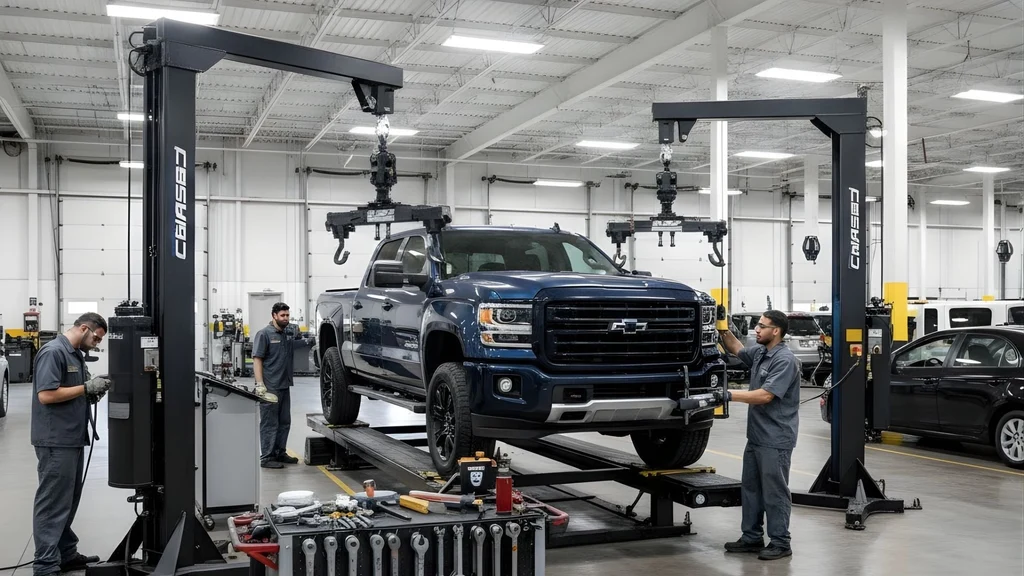
A structural repair bay can become a bottleneck when vehicles are slow to load, tools are difficult to position or the equipment occupies more space than the work requires. Choosing a suitable frame machine body shop setup involves planning the entire workflow around vehicle movement, measuring, pulling and technician access.
Map the Vehicle Journey
The repair process begins before the vehicle reaches the bench.
There should be enough space to approach, align and load damaged vehicles safely. Cars that cannot move under their own power may require dollies, winches or additional handling equipment.
The route should avoid sharp turns, storage areas and busy pedestrian paths. Once the vehicle is on the machine, technicians need room to open doors, remove parts and work around every pulling point.
Completed vehicles must also leave without requiring several other jobs to be moved. A simple loading path can save time repeatedly throughout the week.
Match the Bench to Repair Severity
Different structural jobs require different levels of access and pulling force.
The workshop should assess the proportion of light, medium and severe collision work it handles. A system designed mainly for heavy repairs may be unnecessarily slow for frequent minor pulls, while lighter equipment may limit the workshop’s ability to complete complex work safely.
Vehicle wheelbase, width and weight must fit within the stated capacity. Larger electric vehicles and commercial models may require more load capability than older workshop machinery provides.
Pulling towers should reach the directions commonly required. Technicians need to apply controlled force without creating unsafe angles or repeatedly repositioning the vehicle.
Integrate Measuring and Anchoring
Accurate measurement should be possible throughout the repair, not only before and after pulling.
The measuring system needs clear access beneath and around the vehicle. Cables, targets or mechanical components should not interfere with towers, clamps or lifting points.
Anchoring must hold the vehicle securely without damaging areas that are not intended to carry load. Vehicle-specific procedures and fixtures may be required for modern structures.
Set-up time has a direct effect on throughput. A system that is accurate but requires hours of preparation may reduce the number of repairs the workshop can complete.
Standardising the bay and keeping clamps, fixtures and measuring tools organised nearby can reduce unnecessary movement.
Protect the Space for Structural Work
Repair bays often become temporary storage areas when the workshop is busy. Parts, removed panels and unrelated vehicles can gradually restrict access.
The structural bay should have defined storage for tools and components. Floor markings can help keep pulling zones and walkways clear.
Power, lighting and compressed air need to reach the work without creating trip hazards. Extraction may be necessary when cutting, welding or preparing damaged areas.
Technicians should be able to work safely from several positions, including beneath the vehicle when appropriate.
A productive structural bay is the result of deliberate layout rather than equipment alone. When loading, measuring and repair access are planned together, the frame machine can support consistent throughput instead of becoming a fixed obstacle in the workshop.